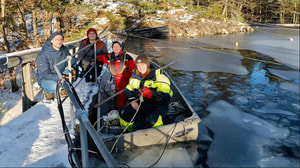
Field site at Risør fjord in Norway.
About
I (she/her) am a marine evolutionary ecologist interested in how organisms respond to environmental change, including how adaptation to local environments in the past influences contemporary plastic responses and current/future environmental adaptation. My research uses interdisciplinary experimental, genomic, and modelling studies of natural populations to understand how these responses are structured across heterogeneous environments and within the genome itself. I believe that the answers to these questions are critical for predicting the persistence of species in the face of environmental change and for managing populations effectively to mitigate biodiversity loss.
I'm an Assistant Professor in the Department of Biological Sciences at the University of New Brunswick Saint John and a researcher at the University of Gothenburg. I also hold research appointments at the University of Agder and the University of Oslo. I lead a transatlantic research program on marine eco-evolutionary dynamics spanning Canada, Sweden, and Norway. We study adaptation and speciation in marine fishes like Atlantic cod and bluefin tuna. Our research program is ultimately aimed at integrating ecological and genomic data into eco-evolutionary models for forecasting population responses to environmental change, which will inform evidence-based decision making while providing insights into the predictability of ecology and evolution.
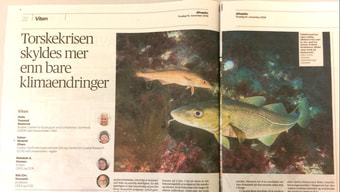
Interests include the role of behaviour and mating systems in environmental responses and adaptation and the impact of human activity on these processes. I co-lead the scientific and artistic project TORSKETROMMING ('COD DRUMMING'), which investigates the role of drumming vocalizations in the Atlantic cod mating ritual and human-cod connection by combining natural scientific, artistic, and social scientific practices. Our performances, sound installations, and musical lectures have been held at Ultima Contemporary Music Festival, Only Connect Festival, Barents Spektakel, and Kunsthalle Exnergasse, among others. We also lead children's workshops.
High quality reference genomes are invaluable to genomic forecasting of biodiversity. I am a founding member and former Council Representative for Norway in the European Reference Genome Atlas (ERGA) and the Project Lead for the University of Oslo in Biodiversity Genomics Europe, consortia which aim to sequence the genomes of all eukaryotic species in Europe as part of the Earth Biogenome Project that aims to sequence all such species on Earth in a distributed, inclusive, and just manner. Within ERGA, I co-chair the Ethical, Legal, and Social Issues (ELSI) Committee and Justice, Equity, Diversity, and Inclusion (JEDI) Committee.
I completed my MSc and PhD with Dr. Jeff Hutchings at Dalhousie University on the genomic basis and spatial scale of variation in temperature responses of Atlantic cod. Afterwards, I was a James S. McDonnell Foundation Fellow in Understanding Dynamic and Multi-scale Systems at the University of Oslo and an NSERC Postdoctoral Fellow at the University of Agder.
I'm an Assistant Professor in the Department of Biological Sciences at the University of New Brunswick Saint John and a researcher at the University of Gothenburg. I also hold research appointments at the University of Agder and the University of Oslo. I lead a transatlantic research program on marine eco-evolutionary dynamics spanning Canada, Sweden, and Norway. We study adaptation and speciation in marine fishes like Atlantic cod and bluefin tuna. Our research program is ultimately aimed at integrating ecological and genomic data into eco-evolutionary models for forecasting population responses to environmental change, which will inform evidence-based decision making while providing insights into the predictability of ecology and evolution.
Interests include the role of behaviour and mating systems in environmental responses and adaptation and the impact of human activity on these processes. I co-lead the scientific and artistic project TORSKETROMMING ('COD DRUMMING'), which investigates the role of drumming vocalizations in the Atlantic cod mating ritual and human-cod connection by combining natural scientific, artistic, and social scientific practices. Our performances, sound installations, and musical lectures have been held at Ultima Contemporary Music Festival, Only Connect Festival, Barents Spektakel, and Kunsthalle Exnergasse, among others. We also lead children's workshops.
High quality reference genomes are invaluable to genomic forecasting of biodiversity. I am a founding member and former Council Representative for Norway in the European Reference Genome Atlas (ERGA) and the Project Lead for the University of Oslo in Biodiversity Genomics Europe, consortia which aim to sequence the genomes of all eukaryotic species in Europe as part of the Earth Biogenome Project that aims to sequence all such species on Earth in a distributed, inclusive, and just manner. Within ERGA, I co-chair the Ethical, Legal, and Social Issues (ELSI) Committee and Justice, Equity, Diversity, and Inclusion (JEDI) Committee.
I completed my MSc and PhD with Dr. Jeff Hutchings at Dalhousie University on the genomic basis and spatial scale of variation in temperature responses of Atlantic cod. Afterwards, I was a James S. McDonnell Foundation Fellow in Understanding Dynamic and Multi-scale Systems at the University of Oslo and an NSERC Postdoctoral Fellow at the University of Agder.
TEACHING @ UNB
Evolution (BIOL 3022)
Functional Ecology of Coastal Fishes, Marine Semester Field Course (BIOL 3953)
Marine Behavioural Ecology (BIOL 4445)
Functional Ecology of Coastal Fishes, Marine Semester Field Course (BIOL 3953)
Marine Behavioural Ecology (BIOL 4445)
News:
01/05/24: Welcome summer/honours students Stephanie Maheux and Abbi Scher to the lab! They'll collaborate with Fisheries & Oceans Canada to understand the genomic basis of migration and recovery in Atlantic bluefin tuna.
12/04/24: Our lab is officially funded by the Canadian Foundation for Innovation (CFI), Natural Sciences and Engineering Research Council of Canada (NSERC), and the New Brunswick Innovation Foundation (NBIF)! Exciting research ahead!
08/04/24: Our new Food for Thought article 'The International Union for Conservation of Nature Red List does not account for intraspecific diversity' focused on Atlantic cod and sugar kelp is out in ICES Journal of Marine Science.
05/01/24: Well the first 6 months flew by! I'm delighted to welcome MSc student Rebecca Krohman (University of New Brunswick) and PhD student Claudia Lacroix (University of Agder) to the lab! They will study the genomic architecture (Rebecca) and bioacoustics (Claudia) of cod in relation to their environment.
01/07/23: On my first day as a professor I have the honour of welcoming new PhD student Simon Henriksson to the lab! Simon is based at Tjärnö Marine Laboratory and will uncover the genomic basis of cod ecotype divergence.
30/06/23: New preprint from the Sampling & Sample Processing Committee of the European Reference Genome Atlas: 'Contextualising samples: supporting reference genomes for European biodiversity through sample and associated metadata collection'.
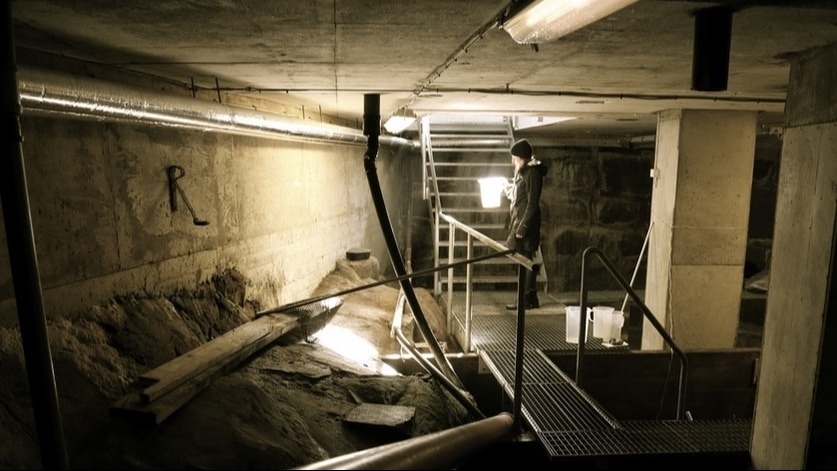
29/06/23: The TORSKETROMMING team had a blast in Harstad, Norway this week presenting our new sound sculpture, musical lecture, and children's workshops at the True Northern Arts Festival. Check out the review in NRK!
22/06/23: Huge congratulations to Annika Lie who defended her masters thesis with flying colours today! Annika will join the lab as a Research Assistant this fall to continue her research on cod bioacoustics.
14/06/23: It was an absolute dream to deliver the Early Career Researcher Award talk at the Canadian Society for Ecology and Evolution meeting. I'm so grateful to be a part of this society for the last 14(!) years and look forward to many more!
11/05/23: Honoured to receive the Crafoord Grant for young researchers from the King of Sweden today alongside Crafoord Prize recipient Dolph Schluter. Congratulations to Dolph and the other research grant recipients!
15/04/23: I will be joining the Department of Biological Sciences at the University of New Brunswick Saint John as an Assistant Professor starting July 1st! I'm thrilled to join such a vibrant department focused on the coastal ocean.
11/04/23: Our Santa Fe Institute working group Sociality Under Scarcity led by Albert Kao & Helen McCreery published 'Opposing responses to scarcity emerge from functionally unique sociality drivers' today in The American Naturalist.
01/03/23: TORSKETROMMING wraps up another incredible Barents Spektakel! We shared our new sound sculptural installation Dialects of the Deep, a human-cod concert, scientific exhibition, two popular science talks, and 5 children's workshops! Congrats to the team: John Andrew, Anastasia, Maja, Paul, Susanna, and guests Per Anders & Sainkho.
17/02/23: The ERGA Consortium's new review paper on how genomics can help biodiversity conservation is out today in Trends in Genetics.
More...
01/05/24: Welcome summer/honours students Stephanie Maheux and Abbi Scher to the lab! They'll collaborate with Fisheries & Oceans Canada to understand the genomic basis of migration and recovery in Atlantic bluefin tuna.
12/04/24: Our lab is officially funded by the Canadian Foundation for Innovation (CFI), Natural Sciences and Engineering Research Council of Canada (NSERC), and the New Brunswick Innovation Foundation (NBIF)! Exciting research ahead!
08/04/24: Our new Food for Thought article 'The International Union for Conservation of Nature Red List does not account for intraspecific diversity' focused on Atlantic cod and sugar kelp is out in ICES Journal of Marine Science.
05/01/24: Well the first 6 months flew by! I'm delighted to welcome MSc student Rebecca Krohman (University of New Brunswick) and PhD student Claudia Lacroix (University of Agder) to the lab! They will study the genomic architecture (Rebecca) and bioacoustics (Claudia) of cod in relation to their environment.
01/07/23: On my first day as a professor I have the honour of welcoming new PhD student Simon Henriksson to the lab! Simon is based at Tjärnö Marine Laboratory and will uncover the genomic basis of cod ecotype divergence.
30/06/23: New preprint from the Sampling & Sample Processing Committee of the European Reference Genome Atlas: 'Contextualising samples: supporting reference genomes for European biodiversity through sample and associated metadata collection'.
29/06/23: The TORSKETROMMING team had a blast in Harstad, Norway this week presenting our new sound sculpture, musical lecture, and children's workshops at the True Northern Arts Festival. Check out the review in NRK!
22/06/23: Huge congratulations to Annika Lie who defended her masters thesis with flying colours today! Annika will join the lab as a Research Assistant this fall to continue her research on cod bioacoustics.
14/06/23: It was an absolute dream to deliver the Early Career Researcher Award talk at the Canadian Society for Ecology and Evolution meeting. I'm so grateful to be a part of this society for the last 14(!) years and look forward to many more!
11/05/23: Honoured to receive the Crafoord Grant for young researchers from the King of Sweden today alongside Crafoord Prize recipient Dolph Schluter. Congratulations to Dolph and the other research grant recipients!
15/04/23: I will be joining the Department of Biological Sciences at the University of New Brunswick Saint John as an Assistant Professor starting July 1st! I'm thrilled to join such a vibrant department focused on the coastal ocean.
11/04/23: Our Santa Fe Institute working group Sociality Under Scarcity led by Albert Kao & Helen McCreery published 'Opposing responses to scarcity emerge from functionally unique sociality drivers' today in The American Naturalist.
01/03/23: TORSKETROMMING wraps up another incredible Barents Spektakel! We shared our new sound sculptural installation Dialects of the Deep, a human-cod concert, scientific exhibition, two popular science talks, and 5 children's workshops! Congrats to the team: John Andrew, Anastasia, Maja, Paul, Susanna, and guests Per Anders & Sainkho.
17/02/23: The ERGA Consortium's new review paper on how genomics can help biodiversity conservation is out today in Trends in Genetics.
More...
We respectfully acknowledge that UNB stands on the unsurrendered and unceded traditional Wolastoqey (WOOL-US-TOOK-WAY) land. The lands of Wabanaki (WAH-BAH-NAH-KEE) people are recognized in a series of Peace and Friendship Treaties to establish an ongoing relationship of peace, friendship and mutual respect between equal nations. The river that connects our two campuses is known as Wolastoq (WOOL-LUSS-TOOK), along which live Wolastoqiyik (WOOL-US-TOO-GWEEG) – the people of the beautiful and bountiful river. Wolastoq (WOOL-LUSS-TOOK) is also called the St. John River.
All photos are mine unless otherwise specified. This site is optimized for desktop/tablet, so strange things can happen on a mobile/tablet.
All photos are mine unless otherwise specified. This site is optimized for desktop/tablet, so strange things can happen on a mobile/tablet.